








 Work time
Diagnostics: Mon - Sun, 6:00 - 23:00
Polyclinic: Mon - Sun, 8:00 - 20:00

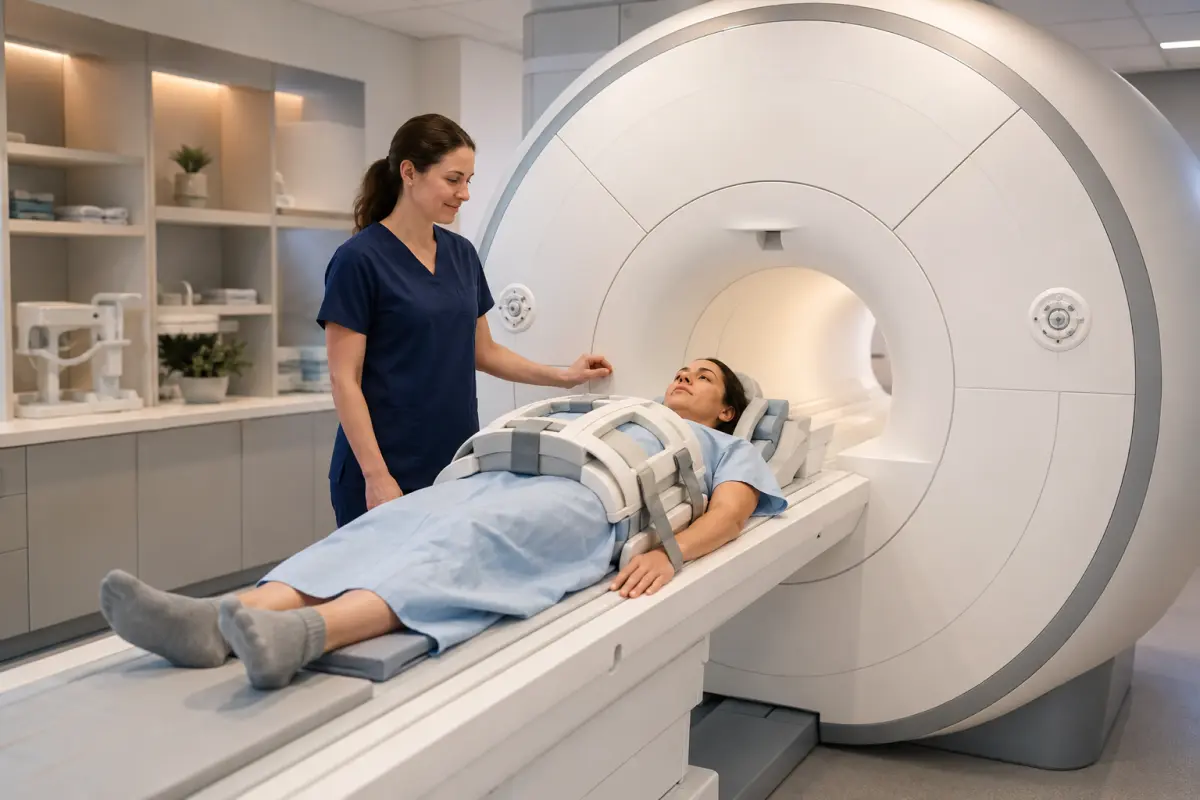
Abdominal MRI — is a modern magnetic resonance imaging examination of the abdominal organs that helps assess the liver, pancreas, spleen, bile ducts, soft tissues, lymph nodes and other structures in detail, depending on the protocol. At the HBMedical medical center in Kyiv, you can undergo MRI of the abdominal organs without contrast or with contrast near Shuliavska metro station.
The examination is performed on a modern Siemens Magnetom Sempra 1.5 Tesla MRI scanner. You can book an abdominal MRI online or by phone. The administrator will help you choose a convenient time, clarify the current price, advise whether contrast is needed and explain how to prepare for the examination.
What is MRI of the abdominal organs?
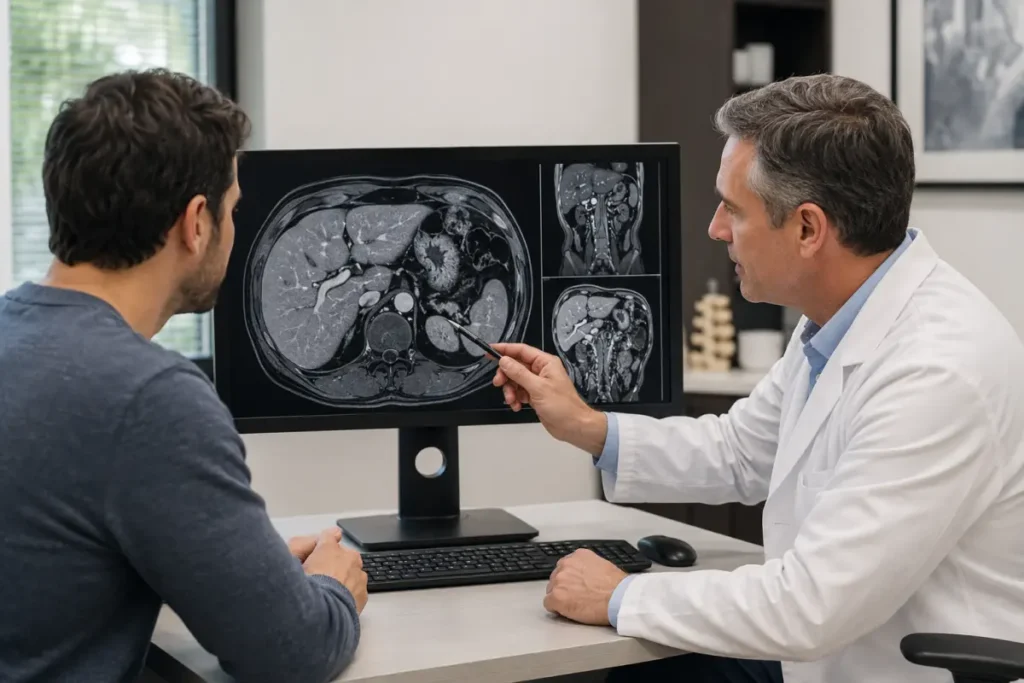
MRI of the abdominal organs — is a diagnostic method that uses a magnetic field and radio waves to obtain detailed images of internal organs and tissues. Unlike CT or X-ray, MRI does not use ionizing radiation.
Abdominal MRI helps the doctor assess organ structure, detect masses, inflammatory changes, cysts, disorders of the biliary system, postoperative changes or other pathological processes. The method is often prescribed by gastroenterologists, surgeons, oncologists, therapists, family doctors or other specialists when it is necessary to clarify a diagnosis after ultrasound, CT, laboratory tests or a physical examination.
At HBMedical, basic MRI of the abdominal organs covers the liver, pancreas and spleen. If the bile ducts need to be assessed separately, the doctor may prescribe MRI of the abdominal organs with MRCP. If assessment of the kidneys and adrenal glands is required, this may be a separate service — MRI of the retroperitoneal organs.
What is included in an abdominal MRI?
The scope of MRI depends on the doctor’s referral and the specific protocol. That is why it is important to provide the exact wording from the referral before booking.
The following options are available at HBMedical:
| Examination | What is assessed |
| MRI of the abdominal organs | Liver, pancreas, spleen |
| MRI of the abdominal organs + MRCP | Liver, pancreas, spleen, bile ducts, non-contrast 3D cholangiopancreatography |
| MRI of the bile ducts | Bile ducts, 3D reconstruction |
| MRI of the retroperitoneal organs | Kidneys and adrenal glands |
| MRI of the abdominal cavity + pelvic organs with a single contrast injection | Abdominal and pelvic organs according to an extended protocol |
If a patient searches for “which organs are included in an abdominal MRI”, it is important to understand that protocols may differ from clinic to clinic. At HBMedical, you should refer to the service name in the price list and the doctor’s referral.
What does an abdominal MRI show?
Abdominal MRI shows the structure of the organs and soft tissues of the abdomen. The method is especially useful when it is necessary to assess the liver, pancreas, spleen, biliary system in detail or clarify ultrasound or CT results.
MRI of the abdominal organs may show:
- cysts and masses;
- benign and malignant tumors;
- liver changes;
- signs of inflammatory processes;
- pathological changes of the pancreas;
- spleen changes;
- tissue structure abnormalities;
- postoperative changes;
- enlarged lymph nodes;
- spread of a pathological process;
- changes that require additional clarification with contrast;
- the condition of the bile ducts when MRCP is performed.
MRI is not a diagnosis in itself. The examination results should be shown to the doctor who referred you for diagnostics. A specialist evaluates MRI findings together with complaints, laboratory tests, ultrasound, CT and other data.
Why is an abdominal MRI performed?
Abdominal MRI is performed when detailed information about the abdominal organs is needed, when a diagnosis must be clarified or when changes detected on ultrasound, CT or laboratory tests need to be checked.
The examination may be prescribed for:
- pain or discomfort in the upper abdomen;
- suspected lesion in the liver, pancreas or spleen;
- changes in liver function tests;
- suspected inflammatory process;
- suspected pancreatic pathology;
- suspected cysts or tumor-like lesions;
- follow-up after surgery;
- oncological monitoring;
- the need to assess the bile ducts;
- the need to clarify ultrasound or CT results;
- contraindications to CT with iodine-containing contrast;
- the need to obtain detailed soft tissue images without X-ray radiation.
If abdominal pain is acute and accompanied by fever, vomiting, jaundice, loss of consciousness, bleeding or a sudden deterioration in condition, you should seek emergency medical care instead of waiting for a scheduled appointment.
Abdominal MRI with contrast
Abdominal MRI with contrast is performed with intravenous administration of a contrast agent. Contrast helps better assess tissue vascularity, lesion borders, the nature of changes, process activity and the extent of pathology.
MRI of the abdominal organs with contrast may be prescribed when it is necessary to:
- clarify the nature of a lesion;
- better assess the liver, pancreas or spleen;
- distinguish scar changes from an active process;
- assess the spread of a tumor process;
- clarify MRI results obtained without contrast;
- check lymph nodes;
- prepare for surgery or monitor treatment.
Contrast enhancement is not required for all patients. It is prescribed according to indications. If the referral states abdominal MRI with contrast, you should report kidney diseases, allergic reactions, pregnancy, breastfeeding and medications you take regularly when booking.
Abdominal MRI without contrast
Abdominal MRI without contrast may be sufficient if the doctor needs to assess the general structure of organs, anatomy, some cystic changes, the condition of the biliary system during MRCP or perform primary clarification for certain indications.
Non-contrast MRI may be prescribed if:
- contrast is not required according to the referral;
- there are contraindications to contrast enhancement;
- basic organ anatomy needs to be assessed;
- MRCP of the bile ducts is required;
- the doctor wants to compare the results with a previous examination.
You should not replace MRI with contrast with MRI without contrast on your own only because of the price. If the doctor prescribed contrast enhancement, it means they need additional diagnostic information.
Abdominal MRI + MRCP
MRCP — is magnetic resonance cholangiopancreatography, a special MRI protocol for assessing the bile ducts and the pancreatic ductal system. At HBMedical, MRI of the abdominal organs with MRCP is available, allowing additional assessment of the bile ducts in 3D format.
This examination may be relevant if impaired bile outflow, bile duct changes or pancreatic pathology are suspected, or when the doctor needs to clarify ultrasound, CT or laboratory test data.
MRCP is often performed without contrast, but in a combined protocol, according to the doctor’s referral, MRI of the abdominal organs with contrast may be prescribed.
Abdominal MRI price at HBMedical
The cost of abdominal MRI depends on the type of examination, the need for contrast enhancement and whether additional protocols, such as MRCP, are required.
| Service | Without contrast | With contrast |
| MRI of the abdominal organs: liver, pancreas, spleen | UAH 5500 | UAH 7850 |
| MRI of the abdominal organs + MRCP: bile ducts, 3D | UAH 5950 | UAH 8400 |
| MRI of the bile ducts, 3D reconstruction | UAH 4850 | not performed |
| MRI of the retroperitoneal organs: kidneys, adrenal glands | UAH 5050 | UAH 7750 |
| MRI of the abdominal cavity + pelvic organs with a single contrast injection | not performed | UAH 9400 |
The examination price includes the doctor’s report and a flash drive. It is better to clarify the current price of MRI of the abdominal organs when booking, because the final cost depends on the wording of the referral, the need for contrast enhancement and the specific diagnostic area.
Preparation for abdominal MRI
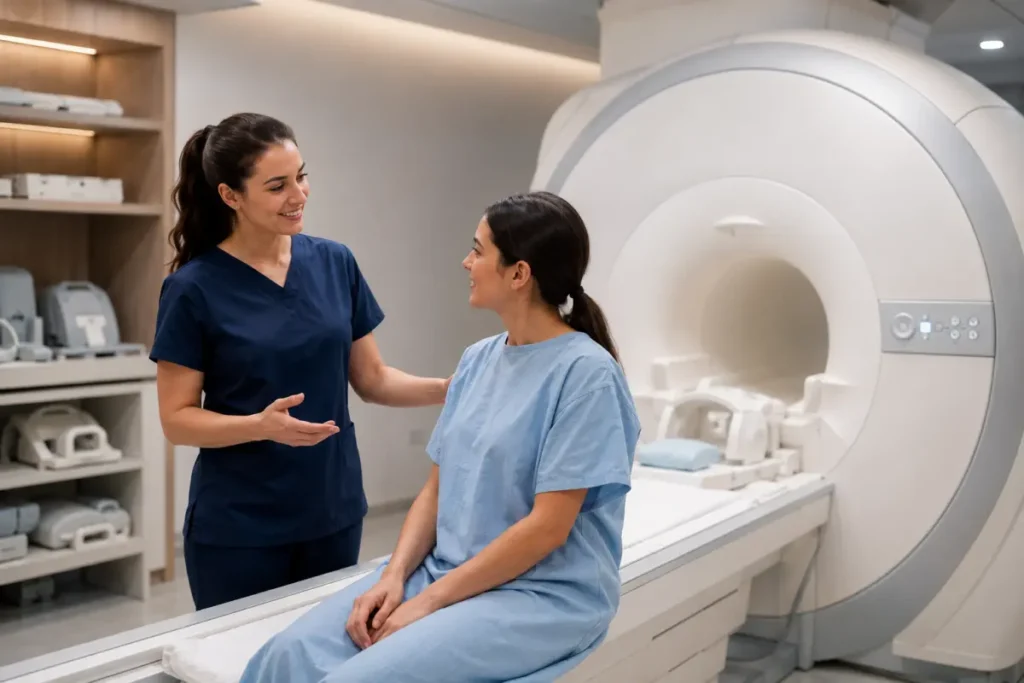
Preparation for abdominal MRI is important because image quality depends on movement during the procedure, intestinal filling, gas formation and following the recommendations before the examination. Exact rules may differ depending on the protocol, so it is better to clarify them when booking.
General recommendations before MRI of the abdominal organs:
- bring your doctor’s referral if you have one;
- bring previous ultrasound, CT, MRI scans, laboratory tests, discharge summaries or postoperative documents;
- clarify when booking how many hours before the procedure you should not eat;
- inform the staff in advance about implants, pacemaker, metal structures, clips, prostheses or foreign metal bodies;
- report pregnancy or possible pregnancy;
- wear comfortable clothing without metal elements;
- remove jewelry, watch, piercings, bank cards and electronic devices;
- do not take laxatives, antispasmodics or other medications on your own without a doctor’s or medical center’s recommendation.
Before abdominal MRI, it is often recommended not to overload the digestive system and to avoid foods that increase gas formation. However, specific preparation depends on the purpose of the examination, so it is better to receive instructions when booking.
How to prepare for abdominal MRI with contrast?
If abdominal MRI with contrast is prescribed, preparation includes not only general rules but also a safety check before administering the contrast agent.
Before MRI with contrast, you need to:
- report kidney diseases;
- report allergic reactions to medications or contrast agents;
- clarify whether a blood creatinine test is required;
- report pregnancy or breastfeeding;
- say which medications you take regularly;
- clarify whether you need to come on an empty stomach;
- bring previous examination results for comparison.
You do not need to stop taking regular medications on your own. If you have chronic diseases, take medications for the kidneys, heart, blood pressure, diabetes or are undergoing oncological treatment, inform the staff before the procedure.
How is an abdominal MRI performed?
The patient arrives at the medical center at the scheduled time, completes registration and fills out an MRI safety questionnaire. Medical staff check whether there are any contraindications to magnetic resonance imaging, implants or metal objects in the body.
Before the procedure, metal items, electronics, jewelry, watches, bank cards and other items that cannot be brought into the MRI room must be left outside. Then the patient lies down on the scanner table. During scanning, it is important to remain still because movement may reduce image quality.
During operation, the machine makes loud sounds — this is a normal part of MRI. If needed, the patient may be provided with noise-reducing accessories. At certain moments, the staff may ask you to hold your breath for a few seconds so that the images of the abdominal organs are clearer.
If the examination is performed with contrast, the contrast agent is administered intravenously through a catheter. After the procedure, a radiologist analyzes the images and prepares a report. The results should be taken to the doctor who referred you for the examination.
CT or abdominal MRI — which is better?
CT and abdominal MRI — are different diagnostic methods, and each has its strengths. It cannot be said that one method is always better than the other. The choice depends on symptoms, previous results, contraindications, urgency and the exact question the doctor wants to clarify.
MRI is better suited for detailed assessment of soft tissues, the liver, pancreas, spleen, biliary system, certain lesions and conditions where avoiding X-ray radiation is important.
CT is more often used when it is necessary to quickly assess abdominal organs, trauma, bleeding, stones, acute conditions, bone structures or a wider anatomical area. CT may also be the method of choice in certain emergency situations.
If the referral states MRI of the abdominal organs, it is better to book this exact examination. If there are doubts between CT and MRI, you should clarify with your doctor which method is needed in your specific case.
Abdominal MRI or ultrasound?
Ultrasound is often the first diagnostic method for abdominal organs. It is accessible, quick and well suited for the initial assessment of the liver, gallbladder, pancreas, spleen and other structures.
MRI is prescribed when more detail is needed, when a complex case must be clarified, when the nature of a lesion needs to be assessed, when the bile ducts need to be checked or when ultrasound data need to be supplemented. Ultrasound and MRI do not always replace each other — they are often used sequentially.
Contraindications to abdominal MRI
MRI has limitations due to the strong magnetic field. Before the procedure, it is essential to report all implants, surgeries and foreign metal objects in the body.
MRI may be contraindicated or require additional approval in case of:
- a pacemaker or another electronic implant if it is not MRI-compatible;
- cochlear implants;
- some vascular clips;
- metal fragments or foreign bodies;
- certain types of prostheses or implants;
- the first trimester of pregnancy — by the doctor’s decision;
- inability to lie still;
- severe claustrophobia.
For MRI with contrast, it is also important to report severe kidney diseases, pregnancy, breastfeeding and previous reactions to contrast agents.
Why have an abdominal MRI at HBMedical near Shuliavka?
HBMedical — is a modern medical center in Kyiv where you can undergo MRI of the abdominal organs on a Siemens Magnetom Sempra 1.5 Tesla scanner. The center is conveniently located near Shuliavska metro station, which is suitable for patients from Shevchenkivskyi, Solomianskyi, Sviatoshynskyi districts, KPI, Nyvky, Lukianivka, Dorohozhychi and other areas of Kyiv.
Advantages of HBMedical:
- convenient location near Shuliavska metro station;
- address: Kyiv, 3 O. Dovzhenka St.;
- modern Siemens Magnetom Sempra 1.5 Tesla MRI scanner;
- abdominal MRI with and without contrast;
- possibility of MRI of the abdominal organs + MRCP;
- online or phone booking;
- diagnostics daily from 6:00 to 23:00;
- clear abdominal MRI pricing;
- the price includes the doctor’s report and a flash drive;
- possibility to undergo additional examinations or consultations in one medical center.
How to book an abdominal MRI in Kyiv?
To book MRI of the abdominal organs at HBMedical, leave a request on the website or call the medical center. When booking, it is advisable to provide the exact wording from the referral: MRI of the abdominal organs, abdominal MRI with contrast, MRI of the abdominal organs + MRCP, MRI of the bile ducts or MRI of the retroperitoneal organs.
The administrator will help you choose a convenient time, clarify the current price, explain preparation for abdominal MRI and advise which documents or previous examination results you should bring with you.
HBMedical — MRI of the abdominal organs in Kyiv
Address: Kyiv, 3 O. Dovzhenka St., Shuliavska metro station
Services: abdominal MRI, abdominal MRI with contrast, abdominal MRI + MRCP
Price: from UAH 5500
Booking: online or by phone
Frequently asked questions about abdominal MRI
What does an abdominal MRI show?
Abdominal MRI shows the structure of the abdominal organs, particularly the liver, pancreas and spleen. With a separate protocol, the bile ducts, kidneys, adrenal glands or pelvic organs can be assessed.
What is included in an abdominal MRI?
At HBMedical, basic MRI of the abdominal organs includes the liver, pancreas and spleen. If the bile ducts need to be assessed, MRI with MRCP may be prescribed. The kidneys and adrenal glands belong to a separate examination of the retroperitoneal space.
How much does an abdominal MRI cost in Kyiv?
At HBMedical, MRI of the abdominal organs costs UAH 5500 without contrast and UAH 7850 with contrast. MRI of the abdominal organs + MRCP costs UAH 5950 without contrast and UAH 8400 with contrast.
Where can I have an abdominal MRI near Shuliavka?
MRI of the abdominal organs can be performed at the HBMedical medical center in Kyiv at the address: 3 O. Dovzhenka St., near Shuliavska metro station.
When is abdominal MRI with contrast needed?
MRI with contrast may be prescribed to clarify the nature of a lesion, assess the spread of a pathological process, lymph nodes, postoperative changes or complex cases when information without contrast may be insufficient.
How should I prepare for an abdominal MRI?
Preparation depends on the protocol. Usually, you need to bring a referral and previous examination results, clarify dietary rules before the procedure, and report implants, metal structures, pregnancy and contraindications to MRI.
How should I prepare for abdominal MRI with contrast?
Before MRI with contrast, you need to report kidney diseases, allergic reactions, pregnancy, breastfeeding and medications you take. You should also clarify whether a blood creatinine test is required.
How is an abdominal MRI performed?
The patient lies on the scanner table while the machine takes a series of images. During the procedure, you need to remain still and sometimes hold your breath for a few seconds. If the examination is performed with contrast, the contrast agent is administered intravenously.
Why is abdominal MRI performed?
Abdominal MRI is performed to assess the liver, pancreas, spleen, biliary system, masses, inflammatory changes, postoperative changes or to clarify ultrasound, CT or laboratory test results.
Which is better: MRI or CT of the abdominal organs?
MRI is better suited for detailed assessment of soft tissues, the liver, pancreas, spleen and biliary system. CT is more often used for quick assessment of acute conditions, trauma, stones, bleeding or a wider anatomical area. The choice of method should be made by a doctor.
Is abdominal MRI painful?
No, the procedure itself is painless. Discomfort may be related to the noise of the machine, the need to lie still, hold your breath or the administration of contrast through a venous catheter.
Can I have an abdominal MRI without a referral?
It is advisable to have a doctor’s referral because it helps correctly determine the examination protocol, the need for contrast and the diagnostic area. If you do not have a referral, it is better to consult a gastroenterologist, surgeon, oncologist, therapist or family doctor beforehand.





Саме до таких фахівців, в разі необхідності, є бажання повернутися!
























Need specialist help?
Order a callback and our consultant will help you choose a doctor and make an appointment at a convenient time for you!