








 Work time
Diagnostics: Mon - Sun, 6:00 - 23:00
Polyclinic: Mon - Sun, 8:00 - 20:00

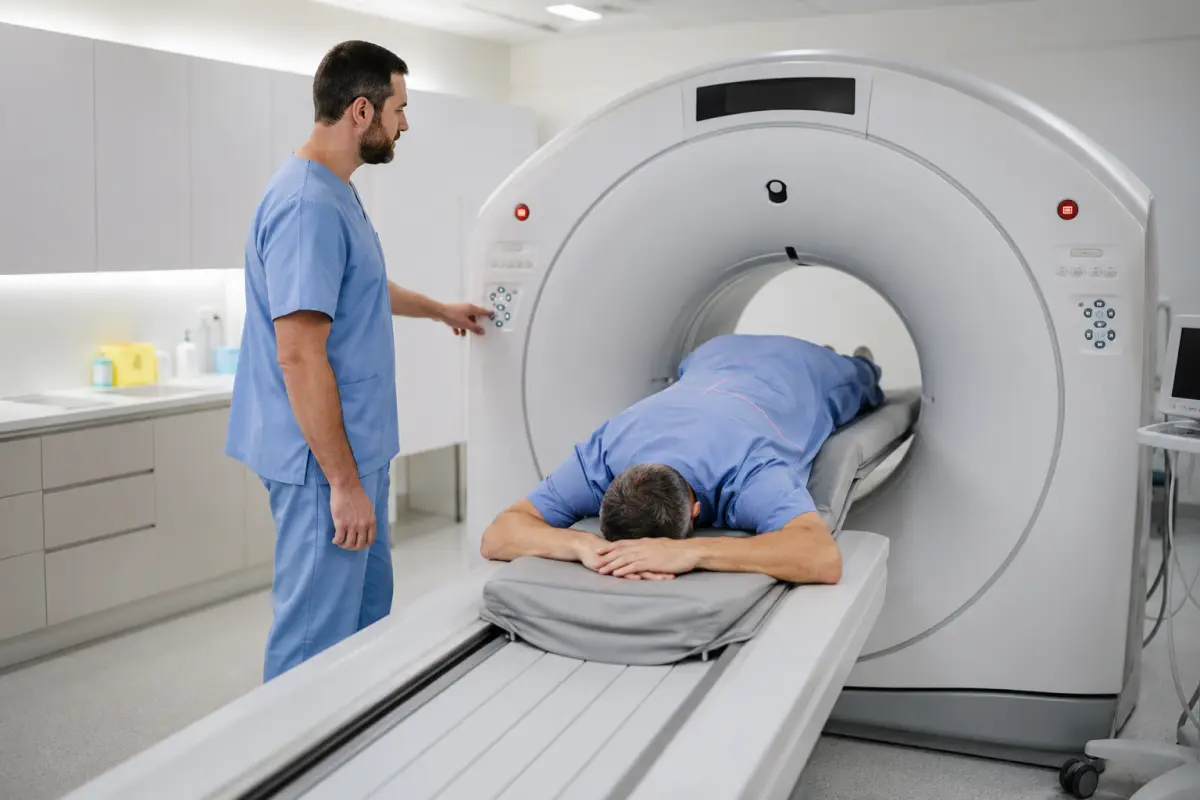
A CT scan of the thoracic spine is computed tomography of the middle part of the back, which allows detailed assessment of the thoracic vertebrae, bone structures, spinal canal, joint surfaces, consequences of injuries, compression fractures, degenerative changes, deformities, and postoperative condition. At the HBMedical medical center in Kyiv, you can undergo a CT scan of the thoracic spine near Shuliavska metro station at the address: 3 O. Dovzhenka St.
The examination may be needed for pain between the shoulder blades, back injury, suspected fracture, spinal deformity, osteoporosis, scoliosis, kyphosis, postoperative follow-up, or when it is necessary to clarify the results of an X-ray or MRI. You can book a CT scan of the thoracic spine online or by phone.
What is a CT scan of the thoracic spine?
A CT scan of the thoracic spine is a layer-by-layer X-ray scan of the back area from the lower part of the neck to the lower back. The scanner creates a series of detailed images that help the doctor assess the condition of the thoracic vertebrae, costovertebral joints, bone structures, and spinal canal.
The thoracic spine is less mobile than the cervical or lumbar spine, so acute pain in this area is often associated with injuries, overload, degenerative changes, poor posture, compression fractures, or changes related to osteoporosis. If the doctor needs to see bone structures in detail, CT is one of the most informative methods.
Patients may search for this examination as “thoracic CT”, “CT scan of the thoracic spine”, “CT scan of the back between the shoulder blades”, or “computed tomography of the thoracic spine”. In the medical price list, the correct name of the service is CT scan of the thoracic spine.
What does a CT scan of the thoracic spine show?
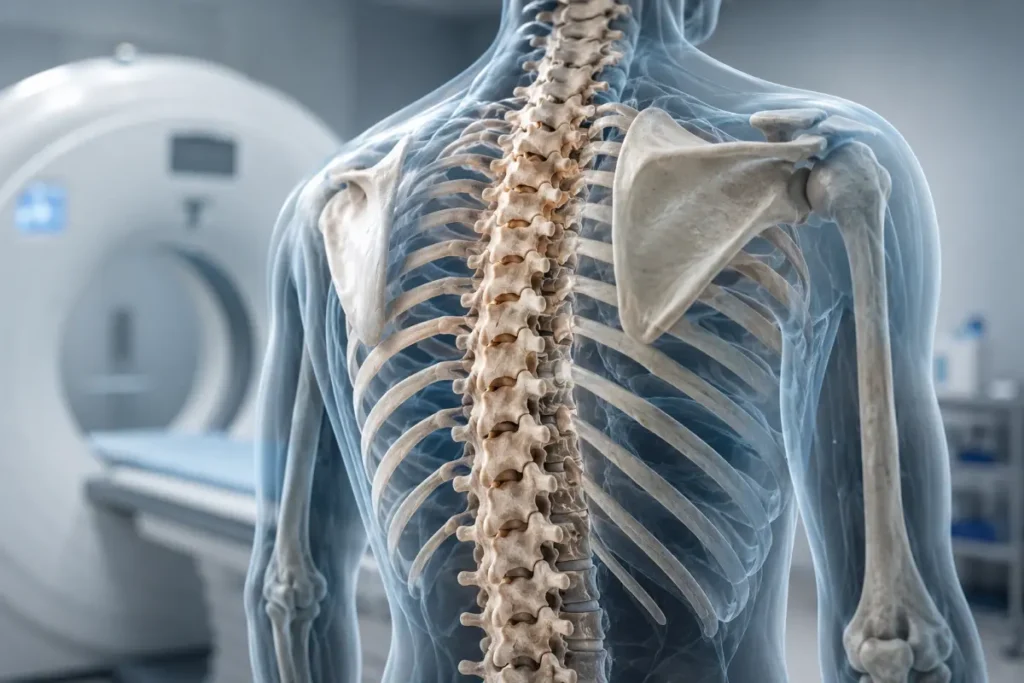
A CT scan of the thoracic spine primarily shows bone structures: thoracic vertebrae, their shape, height, position, joint surfaces, spinal canal, intervertebral foramina, and areas of possible damage. The examination helps detect changes that may not be sufficiently visible on a standard X-ray.
A CT scan of the thoracic spine can show:
- compression fractures of the thoracic vertebrae;
- cracks and consequences of injuries;
- vertebral displacement;
- deformities of the thoracic spine;
- signs of scoliosis or kyphotic deformity;
- degenerative spinal changes;
- bony overgrowths, osteophytes;
- signs of spondylosis or spondyloarthrosis;
- narrowing of the spinal canal;
- narrowing of the intervertebral foramina;
- congenital structural features of the vertebrae;
- postoperative condition;
- position of metal structures, screws, plates, or implants;
- bone changes in inflammatory or tumor processes;
- consequences of old thoracic spine injuries.
It is important to understand: CT shows bones well, but it is not always the main method for assessing intervertebral discs, the spinal cord, nerve roots, ligaments, and soft tissues. If the doctor needs to assess a hernia, protrusion, or nerve structures in detail, an MRI of the thoracic spine may be required.
When is a CT scan of the thoracic spine prescribed?
A CT scan of the thoracic spine may be prescribed by a traumatologist, orthopedist, neurologist, neurosurgeon, surgeon, oncologist, or family doctor. Most often, the examination is needed after injuries, with prolonged pain in the middle part of the back, or when there is suspicion of changes in the bone structures of the spine.
A CT scan of the thoracic spine may be recommended if there is:
- back pain between the shoulder blades;
- pain in the thoracic spine after a fall, impact, or road accident;
- suspected compression fracture;
- suspected crack or other vertebral injury;
- pain after physical exertion or sudden movement;
- limited movement in the thoracic spine;
- suspected spinal deformity;
- scoliosis, kyphosis, or other postural disorders as prescribed by a doctor;
- back pain associated with osteoporosis;
- suspected degenerative spinal changes;
- postoperative follow-up;
- presence of a metal structure in the examination area;
- need to clarify X-ray results;
- preparation for surgical or orthopedic treatment.
If pain in the thoracic spine is accompanied by severe chest pain, shortness of breath, cold sweat, heart rhythm disturbance, weakness, or a sudden worsening of condition, urgent medical help is required. Not every pain in the chest or between the shoulder blades is related to the spine.
CT scan of the thoracic spine after injury
After back injuries, a CT scan of the thoracic spine helps quickly assess whether there is a fracture, crack, displacement, or compression injury of a vertebra. This is especially important after falling on the back, a road accident, an impact, a sports injury, or a workplace injury.
A standard X-ray may be the first stage of diagnosis, but it does not always provide enough information. If the pain persists, there is suspicion of a complex fracture, or the doctor needs to assess the vertebrae in detail, computed tomography may be prescribed.
A CT scan of the thoracic spine after injury helps the doctor understand the nature of the damage, assess spinal stability, and determine further treatment or rehabilitation tactics.
CT scan of the thoracic spine for pain between the shoulder blades
Pain between the shoulder blades can have different causes: muscle strain, posture problems, degenerative spinal changes, consequences of injuries, compression fractures, or diseases of internal organs. That is why it is important not just to “take an image”, but to choose the correct diagnostic method based on a doctor’s recommendation.
A CT scan of the thoracic spine may be useful if the pain:
- lasts a long time and does not go away after treatment;
- appeared after a fall or impact;
- worsens with movement or exertion;
- is accompanied by a feeling of stiffness;
- occurs in the context of osteoporosis;
- requires clarification after an X-ray;
- is associated with suspected bone changes in the spine.
If the main concern involves muscles, ligaments, intervertebral discs, or nerve structures, the doctor may recommend MRI. If it is necessary to assess vertebrae, fractures, bony overgrowths, deformities, or postoperative condition — CT is more often prescribed.
CT scan of the thoracic spine for compression fracture
A compression fracture is an injury in which the vertebral body decreases in height due to compression. Such fractures can occur after injuries or falls, and in people with osteoporosis — even after minor exertion.
A CT scan of the thoracic spine helps assess the height of the vertebra, the shape of the injury, the degree of deformity, the presence of bone fragments, and the condition of adjacent structures. This is important for choosing treatment: conservative observation, orthopedic fixation, rehabilitation, or consultation with a neurosurgeon.
If pain in the thoracic spine appeared suddenly after a fall or physical load, especially in older patients or in cases of osteoporosis, it is worth contacting a doctor without delay.
CT scan of the thoracic spine with and without contrast
In most cases, a CT scan of the thoracic spine is performed without contrast. This is usually sufficient to assess injuries, fractures, cracks, deformities, degenerative changes, osteophytes, or postoperative condition.
A CT scan of the thoracic spine with contrast is not always necessary. Contrast enhancement may be recommended by a doctor if it is necessary to clarify a tumor lesion, inflammatory process, postoperative changes, soft tissue condition, or a complex clinical case.
You should not choose CT with contrast on your own “to make it more accurate”. The use of contrast must be justified by the medical task. If the referral specifies CT with contrast, before the procedure you should report allergies, chronic diseases, and take a creatinine blood test.
How much does a CT scan of the thoracic spine cost at HBMedical?
At HBMedical, the price of a CT scan of the thoracic spine depends on whether contrast enhancement is needed.
| Service | Price |
| CT scan of the thoracic spine without contrast | UAH 1850 |
| CT scan of the thoracic spine with contrast | UAH 3800 |
The cost of the examination includes a doctor’s report and a flash drive. It is better to confirm the current price of a CT scan of the thoracic spine when booking, because the final protocol depends on the doctor’s referral and the clinical situation.
If you have a referral, tell the administrator its wording. This will help choose the correct service: CT scan of the thoracic spine without contrast, CT with contrast, or another type of diagnostics.
How is a CT scan of the thoracic spine performed?
A CT scan of the thoracic spine is quick and painless. The patient arrives at the medical center at the scheduled time, completes registration, provides the doctor’s referral and previous examination results, if available.
Before the procedure, it is necessary to remove metal objects that may enter the scanning area: jewelry, clothing elements with metal, accessories, or other items that may affect image quality. Then the patient lies down on the scanner table. During scanning, it is important to remain still so that the images are clear.
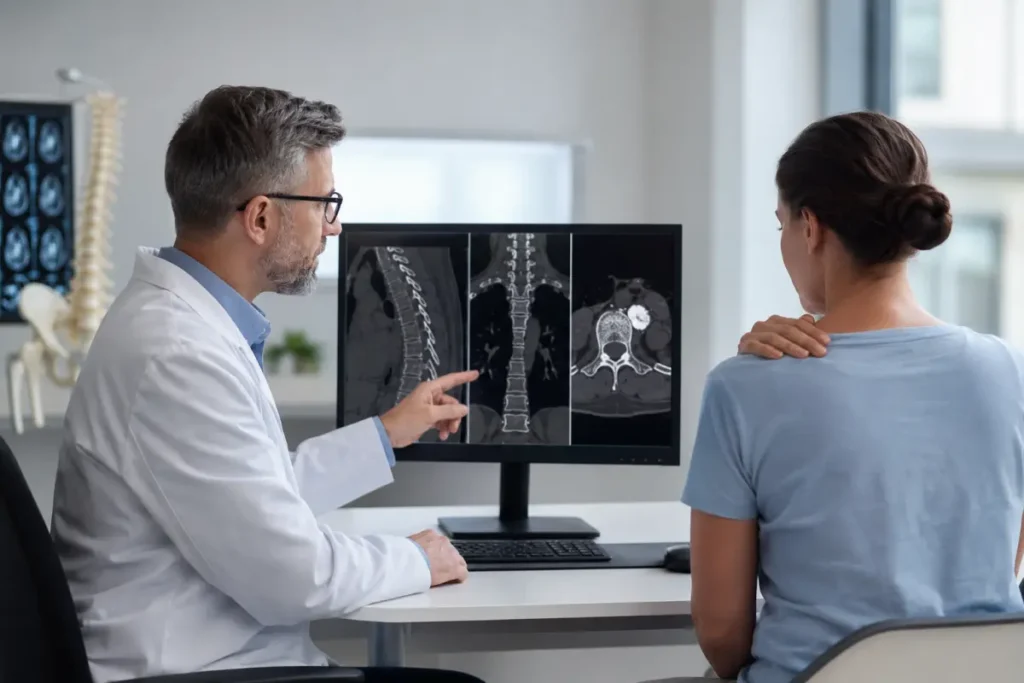
The scanner takes a series of layer-by-layer images of the thoracic spine. After the procedure, a radiologist analyzes the obtained data and prepares a report. The results should be shown to the doctor who referred the patient for the examination.
If CT is performed with contrast, before the procedure the medical staff will clarify allergic reactions, kidney condition, chronic diseases, and creatinine test results.
How to prepare for a CT scan of the thoracic spine?
For a CT scan of the thoracic spine without contrast, special preparation is usually not required. It is enough to arrive at the scheduled time and bring medical documents with you.
Before CT, it is advisable to bring:
- a doctor’s referral, if available;
- results of previous X-ray, CT, or MRI examinations;
- discharge summaries after injuries or operations;
- documents regarding implants or metal structures, if available;
- comfortable clothing without metal elements in the thoracic area;
- a list of medications you take regularly, if contrast is planned.
If CT with contrast is prescribed, a creatinine blood test may be required. You should also report any allergy to iodine or contrast agents, kidney disease, thyroid disease, diabetes, pregnancy, or breastfeeding.
Are there contraindications to a CT scan of the thoracic spine?
CT uses X-ray radiation, so the examination is performed according to medical indications. The main limitation is pregnancy or possible pregnancy. The procedure may also be difficult if the patient cannot lie still due to pain, anxiety, or another condition.
For CT with contrast, there are additional limitations:
- allergy to iodine-containing contrast;
- severe kidney failure;
- severe reactions to contrast in the past;
- certain thyroid diseases;
- decompensated diabetes mellitus;
- severe general condition;
- breastfeeding — requires separate discussion with a doctor.
If you have chronic diseases or previously had reactions to contrast, report this when booking the appointment.
CT or MRI of the thoracic spine — which should you choose?
CT and MRI of the thoracic spine have different diagnostic capabilities. CT is better suited for assessing bones: vertebrae, fractures, cracks, osteophytes, deformities, postoperative changes, and metal structures.
MRI is more often used to assess intervertebral discs, protrusions, hernias, nerve roots, the spinal cord, ligaments, and soft tissues. If the main suspicion concerns nerve structures or discs, the doctor may recommend MRI.
You should not choose the method based only on price or speed. If the referral specifies a CT scan of the thoracic spine, it is better to book this exact examination. If you have doubts, it is worth clarifying with your doctor which method is needed in your case.
How does a CT scan of the thoracic spine differ from a CT scan of the chest organs?
A CT scan of the thoracic spine and a CT scan of the chest organs are different examinations. A CT scan of the thoracic spine is aimed at assessing the vertebrae and bone structures of the middle part of the back. A CT scan of the chest organs assesses the lungs, mediastinum, and other structures of the chest.
Therefore, before booking, it is important to read the referral correctly. If the doctor prescribed “CT scan of the thoracic spine”, the spine should be examined. If the referral states “CT scan of the chest organs” or “CT scan of the lungs”, this is a different service with a different diagnostic purpose.
Why choose HBMedical in Shuliavka for a CT scan of the thoracic spine?
HBMedical is a modern clinical and diagnostic center in Kyiv where you can undergo a CT scan of the thoracic spine in a convenient location near Shuliavska metro station. The center is suitable for patients who need to quickly check the thoracic spine after an injury, clarify the cause of pain between the shoulder blades, or prepare for a consultation with a neurologist, traumatologist, orthopedist, or neurosurgeon.
Advantages of HBMedical:
- convenient location near Shuliavska metro station;
- address: Kyiv, 3 O. Dovzhenka St.;
- modern Siemens computed tomography scanner;
- CT scan of the thoracic spine without contrast and with contrast;
- online or phone appointment booking;
- diagnostics daily from 6:00 to 23:00;
- clear price for CT scan of the thoracic spine;
- radiologist’s report based on the examination results;
- the price includes a doctor’s report and a flash drive;
- possibility to undergo additional examinations or consultations in one medical center.
The location in Shuliavka is convenient for patients from Shevchenkivskyi, Solomianskyi, Sviatoshynskyi districts, KPI, Nyvky, Lukianivka, Dorohozhychi, and other areas of Kyiv.
How to book a CT scan of the thoracic spine in Kyiv?
To book a CT scan of the thoracic spine at HBMedical, leave a request on the website or call the medical center. When booking, it is advisable to mention whether you have a doctor’s referral, whether contrast is needed, and what symptoms or diagnostic task are indicated in the referral.
The administrator will help choose a convenient time, confirm the current price, explain preparation, and advise which documents or previous examinations are better to bring with you.
HBMedical — CT scan of the thoracic spine in Kyiv
Address: Kyiv, 3 O. Dovzhenka St., Shuliavska metro station
Service: CT scan of the thoracic spine
Price: from UAH 1850
Booking: online or by phone
Frequently asked questions about CT scan of the thoracic spine
How much does a CT scan of the thoracic spine cost in Kyiv?
At HBMedical, a CT scan of the thoracic spine costs UAH 1850 without contrast and UAH 3800 with contrast. It is better to confirm the current price when booking.
Where can I get a CT scan of the thoracic spine in Shuliavka?
You can undergo a CT scan of the thoracic spine at the HBMedical medical center in Kyiv at the address: 3 O. Dovzhenka St., near Shuliavska metro station.
What does a CT scan of the thoracic spine show?
A CT scan of the thoracic spine shows the thoracic vertebrae, bone structures, spinal canal, compression fractures, cracks, displacements, deformities, degenerative changes, osteophytes, stenosis, postoperative changes, and the position of metal structures.
Does a CT scan of the thoracic spine show hernias?
CT can partially assess intervertebral discs, but MRI is more often prescribed for detailed diagnosis of hernias, protrusions, nerve roots, and the spinal cord. The doctor should determine which method is needed in your case.
Is contrast needed for a CT scan of the thoracic spine?
In most cases, a CT scan of the thoracic spine is performed without contrast. Contrast is needed only for specific indications, for example, if a tumor, inflammatory, or postoperative process is suspected.
Is preparation needed for a CT scan of the thoracic spine?
For CT without contrast, special preparation is usually not required. For CT with contrast, a creatinine blood test and additional recommendations before the procedure may be needed.
Is it painful to have a CT scan of the thoracic spine?
No, the scan itself is painless. The patient lies on the scanner table and must remain still. Discomfort may only be related to back pain or the need to lie in a certain position.
How long does a CT scan of the thoracic spine take?
The scan is performed quickly, but time should be allowed for registration, preparation, instructions, and waiting for results. It is better to clarify the approximate duration when booking.
Are CT scan of the thoracic spine and CT scan of the chest the same thing?
No. A CT scan of the thoracic spine assesses the vertebrae and bone structures of the back. A CT scan of the chest or chest organs assesses the lungs, mediastinum, and other structures of the chest.
Can I have a CT scan of the thoracic spine without a referral?
It is advisable to have a doctor’s referral in order to correctly determine the examination area and the need for contrast. If you do not have a referral, it is worth consulting a neurologist, traumatologist, orthopedist, or another relevant specialist.





Саме до таких фахівців, в разі необхідності, є бажання повернутися!
























Need specialist help?
Order a callback and our consultant will help you choose a doctor and make an appointment at a convenient time for you!