








 Work time
Diagnostics: Mon - Sun, 6:00 - 23:00
Polyclinic: Mon - Sun, 8:00 - 20:00

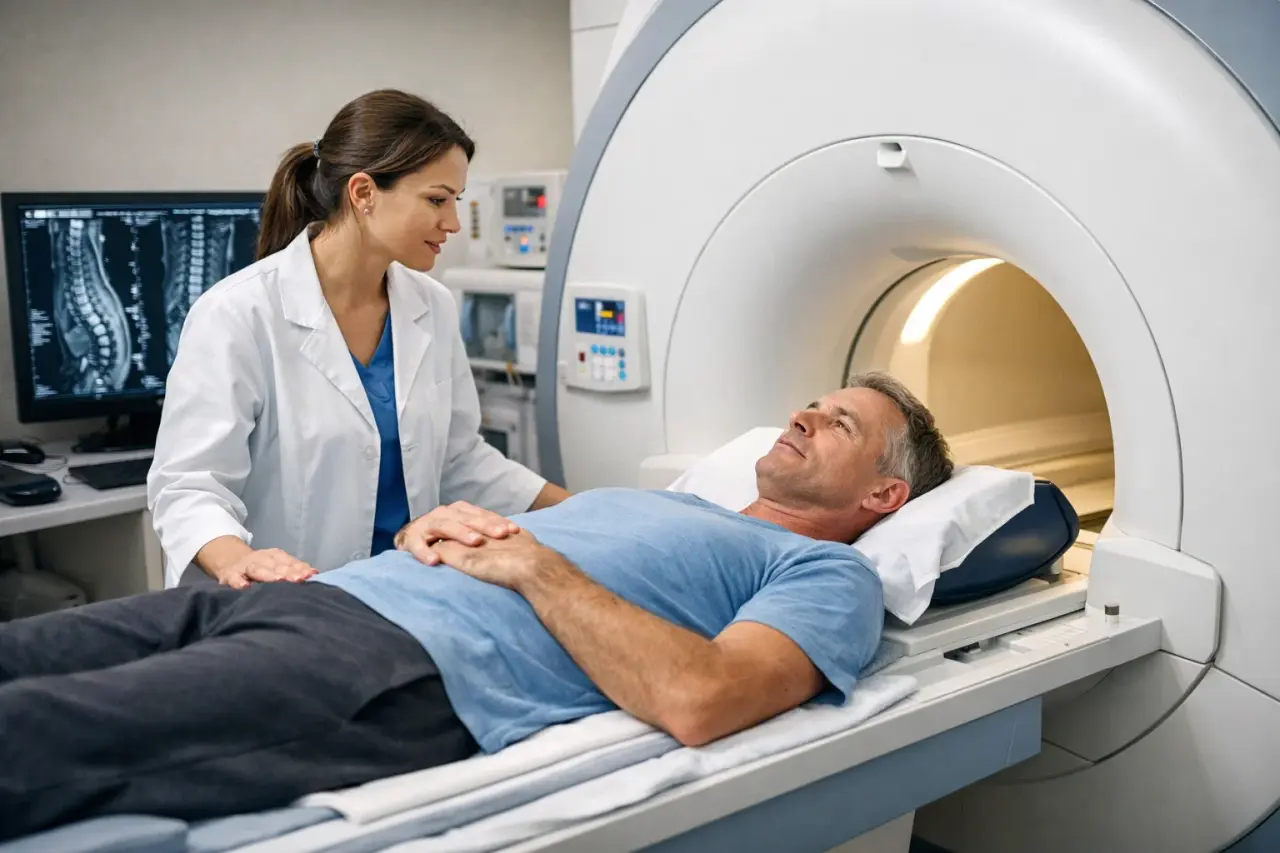
Chronic back pain is a common problem that can significantly reduce a patient’s quality of life. To accurately diagnose the causes of this condition, doctors often recommend magnetic resonance imaging (MRI). In this article, we will explain how MRI helps detect spinal disorders, when you should consult a doctor, and how to prepare for the examination.
What is a spine MRI, and how does it help with chronic back pain?
MRI is a modern imaging method that provides detailed images of soft tissues, intervertebral discs, ligaments, muscles, and nerve structures without the use of X-ray radiation.
How spine MRI works
MRI uses a magnetic field and radio waves to create images. This method makes it possible to detect even minor changes in the structures of the spine that may be causing pain.
Which parts of the spine can be examined with MRI?
MRI can be used to examine:
- Cervical spine — to diagnose pain in the neck and arms.
- Thoracic spine — in cases of discomfort in the chest or back.
- Lumbosacral spine — to identify the causes of pain in the lower back or legs.
Causes of chronic back pain: when should you see a doctor?
Chronic back pain can have various causes. The most common ones include:
Osteochondrosis and degenerative changes
Osteochondrosis refers to age-related changes in the intervertebral discs that reduce their ability to absorb shock.
Herniated discs
A herniated disc occurs when an intervertebral disc protrudes beyond its normal position, which may compress the nerve roots.
Spinal canal stenosis
This is a narrowing of the spinal canal that may lead to compression of the spinal cord or nerve structures.
Scoliosis and other spinal deformities
Scoliosis is a musculoskeletal disorder characterised by a curvature of the spine in the frontal, or lateral, plane and rotation of the vertebrae around their vertical axis.
When does a doctor recommend a spine MRI for back pain?
MRI is an important diagnostic method in the following cases:
- Back pain lasts for more than three months and does not improve after standard treatment.
- Neurological symptoms are present, including numbness, weakness in the limbs, or impaired sensation.
- A spinal injury or spinal cord damage is suspected.
Which spinal conditions can MRI detect?
MRI can detect the following conditions:
Herniated discs: bulges, protrusions, and extrusions
These are among the most common causes of back pain and occur due to displacement or protrusion of the intervertebral discs.
- Inflammatory processes and spinal infections.
- Tumours and other abnormal growths.
- Osteoarthritis and other degenerative conditions.
Advantages of MRI over other methods of diagnosing back pain
MRI offers several advantages that make it an important diagnostic method.
High accuracy and detailed imaging
MRI provides clear images of soft-tissue structures that are difficult to visualise using X-rays or CT scans.
Safety and absence of radiation exposure
This is especially important for patients who need to undergo repeated examinations.
Detection of soft-tissue abnormalities
MRI is well suited for detecting swelling and other changes in the muscles, intervertebral discs, and nerve structures.
How should you prepare for a spine MRI?
To ensure that the procedure goes smoothly, follow these recommendations.
Recommendations before the procedure
- Inform your doctor if you have any metal implants or a pacemaker.
- Wear comfortable clothing without metal elements.
What should you know about MRI contraindications?
Whether MRI can be performed in patients with pacemakers or metal implants depends on the type and compatibility of the implanted device. Pregnant women, especially during the first trimester, should undergo MRI only when prescribed by a doctor and when there are clear medical indications.
Conclusion: what should you do after receiving your MRI results?
Consultation with a neurologist or neurosurgeon
After receiving the results, it is important to consult a specialist who will assess the detected changes and recommend the most appropriate treatment.
Possible treatment options based on MRI results
Depending on the diagnosis, treatment may include medication, physiotherapy, therapeutic exercise, or surgery.
HBMedical Medical Centre provides spine MRI services. Examinations are performed using a 1.5 Tesla SIEMENS MRI scanner, which provides detailed images of the examined area. Patients are offered comfortable conditions and a professional approach. Contact HBMedical Medical Centre to diagnose the causes of chronic back pain.
Prepared by:
Radiologist
I. S. Kovalenko










Мені все сподобалось
Всі профі
Дякую


Велика подяка лікарю Дуброву Є.О. — надзвичайно компетентний і чуйний фахівець, який детально все пояснив, розвіяв тривогу та підтримав морально. Щиро дякую анестезіологу Бєлаш О.М. за високий професіоналізм, чуйність і справжнє людське ставлення — занурення в сон та сам перебіг процедури минули максимально комфортно. Також величезне спасибі медсестрі (на жаль, не дізналася ім'я) за її турботу, доброту та увагу.
Весь персонал вразив своєю чуйністю та теплом. Дякую за ваш труд і турботу про пацієнтів! Однозначно рекомендую.














Дуже ввічливий та приємний персонал клініки. Лікар був уважний, без поспіху пройшовся по всім аспектам здоровʼя. Лабораторія швидко зробила аналізи. В цілому дуже задоволена. Радже звертатися!




Саме до таких фахівців, в разі необхідності, є бажання повернутися!

і закінчуючи отриманим описом і рекомендаціями від лікарів.
























Need specialist help?
Order a callback and our consultant will help you choose a doctor and make an appointment at a convenient time for you!