








 Work time
Diagnostics: Mon - Sun, 6:00 - 23:00
Polyclinic: Mon - Sun, 8:00 - 20:00

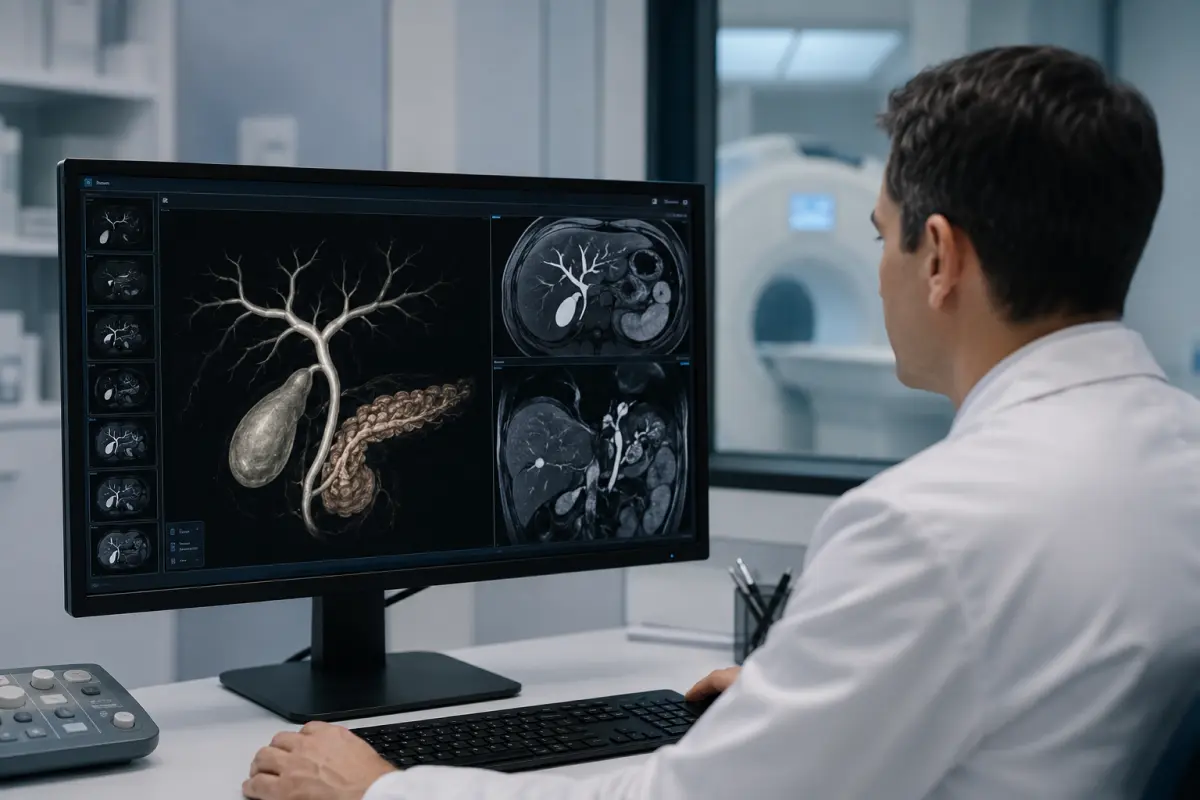
MRCP is a non-invasive magnetic resonance examination of the gallbladder, intrahepatic and extrahepatic bile ducts, and the pancreatic duct. Magnetic resonance cholangiopancreatography helps detect stones, narrowing, dilation, impaired patency, and other structural changes in the ducts without endoscopic intervention or X-ray radiation.
At HBMedical, you can undergo MRCP in Kyiv with 3D reconstruction of the biliary ducts. The examination is performed using a Siemens Magnetom Sempra 1.5 Tesla scanner at: 3 Oleksandra Dovzhenka Street, Kyiv, near Shuliavska metro station.
Standard MRCP at HBMedical is performed without intravenous contrast. When necessary, a comprehensive abdominal MRI with MRCP is available, either without contrast or with contrast enhancement. The appropriate protocol is selected according to the referral and the clinical question.
You can book magnetic resonance cholangiopancreatography by phone or through the form on the website. When booking, state the exact wording from the referral: standalone MRCP or abdominal MRI with MRCP.
MRCP price in Kyiv
HBMedical offers the following examination options:
- MRI of the biliary ducts — cholangiopancreatography with 3D reconstruction: UAH 4,850;
- Abdominal MRI with MRCP without contrast: UAH 5,950;
- Abdominal MRI with MRCP and contrast enhancement: UAH 8,400.
Standalone MRCP is a non-contrast examination. In the comprehensive protocol with contrast, the contrast agent is used for a more detailed assessment of the liver, pancreas, masses, and other abdominal tissues, while images of the bile and pancreatic ducts are produced using dedicated MR sequences.
It is recommended to confirm the current price and available appointment time before booking, as the medical center’s price list may be updated.
What kind of examination is MRCP?
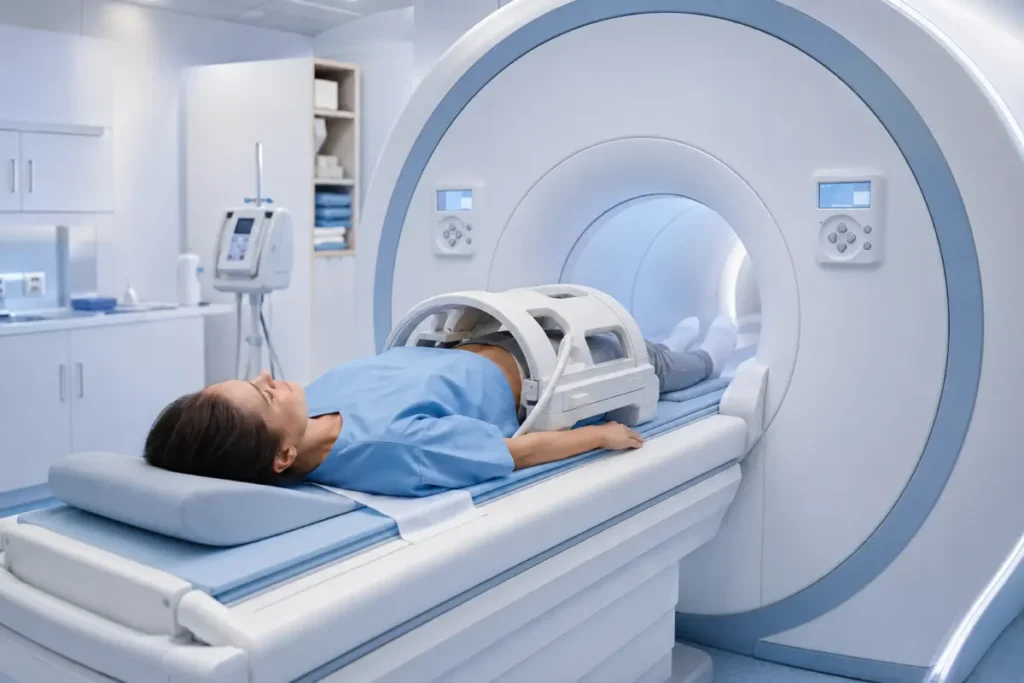
MRCP stands for magnetic resonance cholangiopancreatography. The following terms are also used:
- MR cholangiopancreatography;
- MR cholangiography;
- MRI of the biliary ducts;
- MRI with MRCP;
- MRCP — the English abbreviation.
MRCP is a specialized type of MRI designed primarily to assess fluid within the bile and pancreatic ducts. During scanning, the machine creates a series of cross-sectional images that are used to generate a three-dimensional reconstruction of the ductal system.
The method helps the doctor assess:
- the gallbladder;
- the intrahepatic bile ducts;
- the common hepatic duct;
- the common bile duct;
- the junction of the bile and pancreatic ducts;
- the main pancreatic duct;
- parts of the adjacent liver and pancreatic structures.
MRCP is a diagnostic examination. Stones cannot be removed, a stent cannot be placed, and a biopsy cannot be performed during the procedure.
What does MRCP show?
MR cholangiopancreatography helps assess the anatomy, diameter, and patency of the bile and pancreatic ducts.
MRCP can help detect or clarify:
- stones in the common bile duct;
- dilation of the intrahepatic or extrahepatic ducts;
- narrowing of the bile ducts;
- the level and possible cause of impaired bile drainage;
- inflammatory changes in the biliary system;
- congenital anatomical variations of the ducts;
- bile duct cysts;
- changes in the main pancreatic duct;
- narrowing or dilation of the pancreatic duct;
- changes associated with acute or chronic pancreatitis;
- possible signs of a mass compressing or obstructing a duct;
- postoperative changes;
- the condition of the bile ducts after gallbladder removal;
- the cause of obstructive jaundice;
- abnormal junction of the bile and pancreatic ducts.
MRCP helps visualize the ducts but does not always allow the nature of a detected abnormality to be determined conclusively. Further evaluation may require laboratory tests, ultrasound, contrast-enhanced abdominal MRI, CT, endoscopic ultrasonography, or ERCP.
When is MRCP prescribed?
A referral for MR cholangiopancreatography may be issued by a gastroenterologist, surgeon, hepatologist, oncologist, family doctor, or another specialist.
Possible indications for MRCP include:
- suspected stone in the bile duct;
- dilated bile ducts detected on ultrasound or CT;
- jaundice;
- elevated bilirubin or liver test results;
- pain in the right upper abdomen;
- recurrent episodes of biliary colic;
- signs of impaired bile drainage;
- suspected bile duct stricture;
- acute or chronic pancreatitis;
- the need to assess the pancreatic duct;
- suspected congenital abnormality of the biliary tract;
- follow-up after surgery on the gallbladder or bile ducts;
- pain or other symptoms after gallbladder removal;
- suspected postoperative duct injury or narrowing;
- preparation for an endoscopic or surgical procedure;
- the need to clarify changes detected during another examination.
MRCP is used to evaluate diseases of the liver, gallbladder, bile ducts, and pancreatic ducts, including stones, inflammation, infection, pancreatitis, and suspicious masses.
Bile duct stones on MRCP
One of the common indications for MRCP is suspected choledocholithiasis — stones in the common bile duct.
Stones may obstruct bile drainage and cause:
- pain in the right upper abdomen;
- yellowing of the skin and sclera;
- dark urine;
- pale stools;
- nausea and vomiting;
- fever;
- changes in bilirubin and liver test results;
- acute pancreatitis.
MRCP helps assess the location of a stone, the condition of the ducts above the obstruction, and any possible dilation. If the stone needs to be removed, the patient may be advised to undergo a therapeutic endoscopic procedure — ERCP.
MRCP for pancreatitis
MR cholangiopancreatography can be used to assess the main pancreatic duct and its relationship with the biliary system.
The examination may be useful for:
- identifying a possible biliary cause of pancreatitis;
- assessing dilation or narrowing of the pancreatic duct;
- detecting stones in the distal part of the bile duct;
- assessing congenital variations of the ductal system;
- monitoring changes in chronic pancreatitis;
- planning further examination or treatment.
MRCP alone may not be sufficient for a complete assessment of pancreatic tissue. In such cases, the doctor may prescribe a comprehensive abdominal MRI with MRCP.
MRCP with or without contrast
Standard magnetic resonance cholangiopancreatography is usually performed without an intravenous contrast agent. Images of the ducts are obtained due to the special properties of static fluid — bile and pancreatic secretions.
At HBMedical, the standalone service «MRI of the biliary ducts — cholangiopancreatography» is also performed without contrast.
Contrast enhancement may be required if the doctor also needs to assess:
- liver tissue;
- the structure of the pancreas;
- a detected mass;
- inflammatory changes;
- the blood supply to an abnormal area;
- the extent of a tumor process;
- postoperative changes;
- the cause of external compression of a duct.
In this case, an abdominal MRI with MRCP and intravenous contrast enhancement may be prescribed.
You should not choose between a contrast and non-contrast examination on your own. The most appropriate protocol depends on the symptoms, ultrasound findings, laboratory results, and the doctor’s clinical question.
MRCP and abdominal MRI: what is the difference?
MRCP and a standard abdominal MRI have different primary purposes.
MRCP
The examination is primarily focused on assessing:
- the bile ducts;
- the common bile duct;
- the pancreatic duct;
- the level of impaired bile drainage;
- duct stones and strictures.
Abdominal MRI
Helps provide a more detailed assessment of:
- the liver;
- the pancreas;
- the spleen;
- masses;
- tissue structure;
- inflammatory and postoperative changes.
Abdominal MRI with MRCP
Combines assessment of the parenchymal organs and the biliary system. This comprehensive examination may be appropriate when it is necessary to identify not only the level of duct obstruction but also the possible cause of changes in the liver or pancreas.
HBMedical offers both standalone MRCP and comprehensive abdominal MRI examinations with MRCP.
MRCP and ERCP: what is the difference?
MRCP and ERCP are not the same procedures.
MRCP
- is performed using an MRI scanner;
- does not require insertion of an endoscope;
- does not use X-ray radiation;
- usually does not require intravenous contrast;
- is used for diagnosis;
- cannot remove a stone or place a stent.
ERCP
Endoscopic retrograde cholangiopancreatography is performed using an endoscope that is passed through the mouth into the duodenum. During the procedure, an iodine-containing contrast agent is injected into the ducts and X-ray equipment is used.
ERCP may be used for treatment, including:
- removing stones from the bile ducts;
- dilating a narrowed section;
- placing a stent;
- restoring bile drainage;
- obtaining tissue or other material for examination.
MRCP is a non-invasive diagnostic alternative to ERCP but does not replace it when therapeutic intervention is required.
Preparation for MRCP
Exact preparation instructions should be obtained when booking, as they may depend on the selected protocol and the patient’s condition.
To improve image quality, patients may be advised not to eat for a certain period before MRCP. Food and drink instructions vary between medical facilities, so you should follow the specific instructions provided by HBMedical. Regular medicines are usually taken as usual unless the doctor has given other recommendations.
Before the examination, it is recommended to:
- bring the doctor’s referral;
- bring previous ultrasound, CT, MRI, or endoscopic examination reports;
- bring blood test results, if available;
- inform the staff about previous surgery on the gallbladder, liver, pancreas, or ducts;
- inform the staff about any stents, drains, or other medical devices;
- bring documentation for implants;
- report a pacemaker, defibrillator, neurostimulator, or other electronic device;
- report metal fragments or foreign bodies;
- inform the staff about pregnancy or the possibility of pregnancy;
- report claustrophobia in advance;
- remove jewelry, watches, hearing aids, and other metal objects.
If a comprehensive contrast-enhanced MRI has been prescribed, you should also report kidney disease and previous reactions to contrast agents. If risk factors are present, a creatinine blood test may be required.
How is MRCP performed?
MR cholangiopancreatography is performed using a magnetic resonance scanner and does not require the insertion of an endoscope.
The procedure consists of several stages:
- Safety screening. Before scanning, the patient completes a questionnaire and provides information about implants, operations, medical devices, and other possible restrictions.
- Positioning in the scanner. The patient lies on a movable table. A dedicated receiving coil is positioned over the abdomen.
- Scanning. The table moves into the scanner, and the machine acquires a series of cross-sectional images.
- Breath-holds. During certain sequences, the radiographer may ask the patient to hold their breath for several seconds. This helps reduce motion artifacts.
- 3D reconstruction. The acquired images are used to generate a three-dimensional image of the bile and pancreatic ducts.
- Interpretation of results. The radiologist analyzes the images and prepares a report.
The scanner produces loud rhythmic sounds during operation. Hearing protection is provided, and communication with the staff is maintained throughout the examination.
To obtain diagnostic-quality images, it is important to remain still and follow breathing instructions. Patient movement can reduce the quality of MRCP images.
How long does MRCP take?
The duration depends on the scope of the examination:
- standalone MR cholangiopancreatography;
- abdominal MRI with MRCP;
- a comprehensive contrast-enhanced examination;
- the need for additional sequences.
It is recommended to confirm the approximate duration when booking by giving the administrator the full wording from the referral.
Contraindications and limitations
MRCP is performed in a strong magnetic field. Be sure to inform the staff if you have:
- a pacemaker;
- an implanted cardioverter-defibrillator;
- a cochlear implant;
- a neurostimulator;
- an insulin pump;
- a continuous glucose monitoring system;
- vascular clips;
- metal fragments or foreign bodies;
- other electronic or metal medical devices;
- recent surgery;
- pregnancy;
- severe claustrophobia;
- an inability to remain still or follow breath-hold instructions.
The presence of an implant does not always rule out MRI. Whether the examination can be performed depends on the device model, its MR compatibility, and the conditions specified by the manufacturer.
What does the patient receive after MRCP?
After scanning, the radiologist analyzes the images of the bile and pancreatic ducts and prepares a report.
The patient receives:
- MR images;
- a 3D reconstruction of the ducts;
- a radiologist’s report;
- the results recorded on digital media;
- materials for consultation with a gastroenterologist, surgeon, or another doctor.
At HBMedical, the report can usually be obtained within 5–7 hours, either in person or through the patient portal. In complex cases, the turnaround time may vary.
The MRCP report describes the detected changes but is not a final clinical diagnosis. Further management is determined by the doctor based on the symptoms, laboratory results, and other examinations.
Why undergo MRCP at HBMedical?
- examination using a Siemens Magnetom Sempra 1.5 Tesla scanner;
- standalone MRCP of the biliary ducts;
- 3D reconstruction of the ductal system;
- comprehensive abdominal MRI with MRCP;
- contrast-enhanced examination when indicated;
- image interpretation by a radiologist;
- a report and digital results;
- the possibility of comparison with previous examinations;
- a location near Shuliavska metro station;
- advance booking at a convenient time.
Where to have MRCP in Kyiv
Magnetic resonance cholangiopancreatography is available at HBMedical at: 3 Oleksandra Dovzhenka Street, Kyiv, near Shuliavska metro station.
The location on Kyiv’s right bank is convenient for patients from Shuliavka, KPI, Lukianivka, Dorohozhychi, Nyvky, and the Shevchenkivskyi, Solomianskyi, and Sviatoshynskyi districts.
When booking, tell the administrator:
- the exact examination name from the referral;
- whether standalone MRCP or a comprehensive abdominal MRI is required;
- whether contrast enhancement has been prescribed;
- whether you have had surgery on the gallbladder or bile ducts;
- whether any stents or drains are in place;
- whether previous ultrasound, CT, or MRI results are available;
- whether you have implants or medical devices;
- whether you have claustrophobia.
Book MRCP at HBMedical to have the bile and pancreatic ducts examined in Kyiv near Shuliavska and receive the results for further consultation with your doctor.
Frequently asked questions
What is MRCP?
MRCP is magnetic resonance cholangiopancreatography, a specialized type of MRI used to examine the gallbladder, bile ducts, pancreas, and pancreatic duct.
What does MRCP show?
The examination helps detect stones, narrowing, dilation, and obstruction of the bile or pancreatic ducts, congenital variations, postoperative changes, and other abnormalities of the ductal system.
How much does MRCP cost in Kyiv?
According to HBMedical’s current price list, standalone MRCP with 3D reconstruction costs UAH 4,850. Abdominal MRI with MRCP costs UAH 5,950 without contrast and UAH 8,400 with contrast enhancement.
Is MRCP performed with or without contrast?
Standard MRCP is performed without intravenous contrast. Contrast may be used during a comprehensive abdominal MRI when a more detailed assessment of the liver tissue, pancreas, or a detected mass is required.
How should I prepare for MRCP?
When booking, you should confirm the food and drink instructions, bring the referral and previous results, and report implants, previous operations, pregnancy, and claustrophobia.
How is MRCP performed?
The patient lies on the scanner table while the machine acquires a series of cross-sectional images of the bile and pancreatic ducts. Breath-holding is required during certain sequences. A 3D reconstruction is created from the images.
Is an endoscope inserted during MRCP?
No. MRCP is performed using an MRI scanner without inserting an endoscope into the stomach or intestines.
Can MRCP remove a stone?
No. MRCP is a diagnostic examination. ERCP or surgery may be required to remove a stone from the bile duct.
How does MRCP differ from ERCP?
MRCP is a non-invasive MRI examination. ERCP is performed endoscopically and can be used not only for diagnosis but also to remove stones or place a stent.
Can MRCP be performed after gallbladder removal?
Yes. The examination can be used to assess the bile ducts after cholecystectomy, including in cases of pain, jaundice, or suspected duct stones or narrowing.
Is a referral required for MRCP?
You can confirm whether the examination is available without a referral when booking. A referral is recommended because it helps determine whether standalone MRCP or a comprehensive abdominal MRI is needed.
When will the report be ready?
At HBMedical, the report is usually prepared within 5–7 hours. In complex cases, it may take longer.
This material is for informational purposes only and does not replace a medical consultation.










Мені все сподобалось
Всі профі
Дякую


Велика подяка лікарю Дуброву Є.О. — надзвичайно компетентний і чуйний фахівець, який детально все пояснив, розвіяв тривогу та підтримав морально. Щиро дякую анестезіологу Бєлаш О.М. за високий професіоналізм, чуйність і справжнє людське ставлення — занурення в сон та сам перебіг процедури минули максимально комфортно. Також величезне спасибі медсестрі (на жаль, не дізналася ім'я) за її турботу, доброту та увагу.
Весь персонал вразив своєю чуйністю та теплом. Дякую за ваш труд і турботу про пацієнтів! Однозначно рекомендую.













Дуже ввічливий та приємний персонал клініки. Лікар був уважний, без поспіху пройшовся по всім аспектам здоровʼя. Лабораторія швидко зробила аналізи. В цілому дуже задоволена. Радже звертатися!




Саме до таких фахівців, в разі необхідності, є бажання повернутися!

і закінчуючи отриманим описом і рекомендаціями від лікарів.
























Need specialist help?
Order a callback and our consultant will help you choose a doctor and make an appointment at a convenient time for you!