








 Work time
Diagnostics: Mon - Sun, 6:00 - 23:00
Polyclinic: Mon - Sun, 8:00 - 20:00

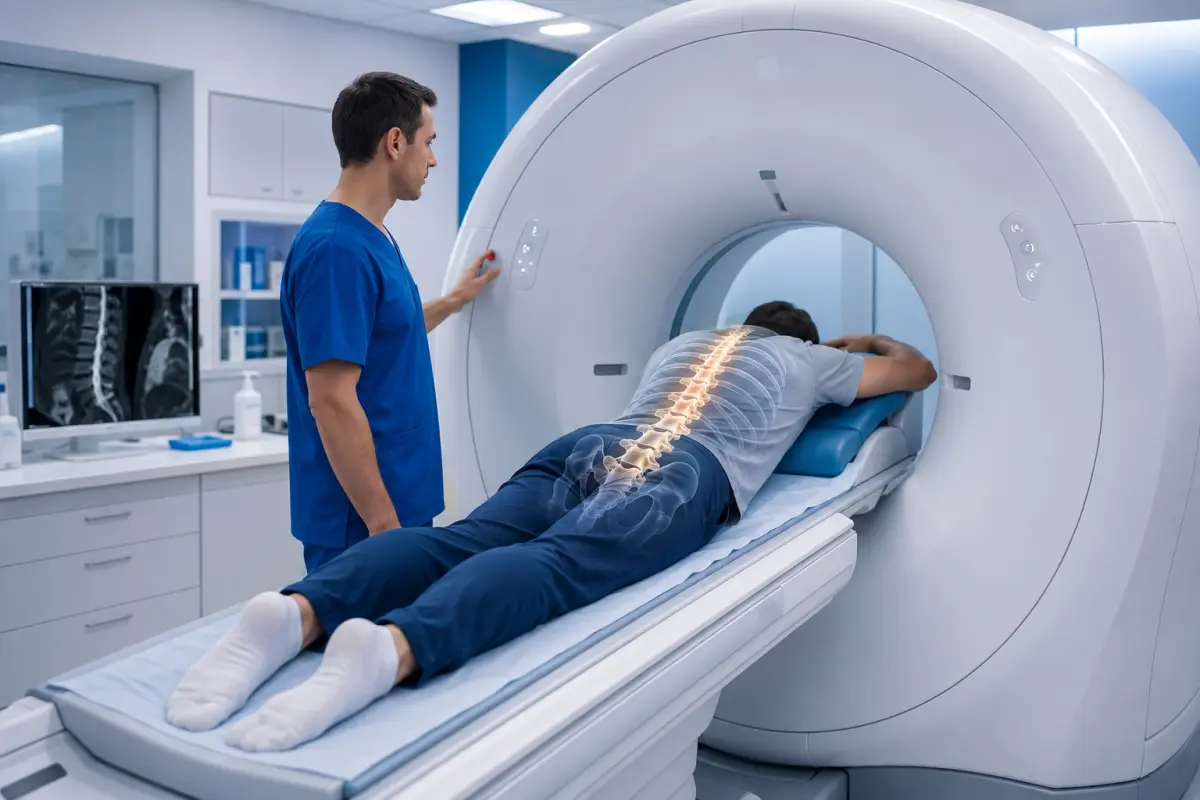
A spine CT scan, or as patients often say — a back CT scan, — is computed tomography of one or several sections of the spine. The examination helps assess the vertebrae, bone structures, spinal canal, consequences of injuries, fractures, degenerative changes, postoperative condition, and the position of metal implants in detail.
At the HBMedical medical center in Kyiv, you can have a CT scan of the cervical, thoracic, or lumbar spine, CT scan of the coccyx and sacrum, as well as CT scan of one spinal section with a metal implant. The center is located near Shuliavska metro station at: Kyiv, 3 O. Dovzhenka St. You can book a spine CT scan online or by phone.
Are back CT and spine CT the same thing?
In everyday language, patients often search for “back CT,” but the medically correct name of the service is spine CT or CT scan of a specific spinal section. The back is a broad anatomical area, so before booking it is important to clarify which section needs to be examined: cervical, thoracic, lumbar, sacrum, or coccyx.
If the doctor’s referral says “spine CT,” “back CT,” “lumbar CT,” “cervical spine CT,” or another wording, the HBMedical administrator will help select the correct service according to your referral. This is important so that you undergo exactly the examination the doctor needs for diagnosis.
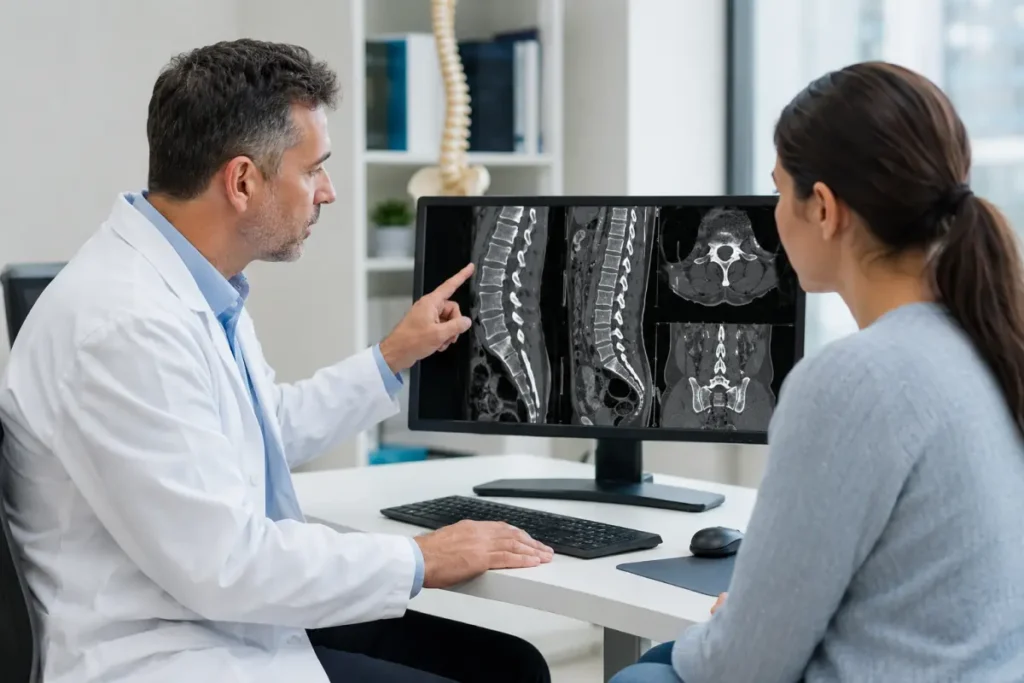
What is a spine CT scan?
A spine CT scan is a layer-by-layer X-ray scan of the selected spinal area followed by computer processing of the images. The scanner creates a series of detailed slices, allowing the doctor to assess the vertebrae, articular surfaces, spinal canal, intervertebral foramina, bone changes, injuries, or postoperative changes.
Computed tomography is especially informative for assessing bone structures. If the main question concerns a fracture, fissure, vertebral displacement, deformity, osteophytes, consequences of injury, or the position of a metal implant, CT can provide the doctor with very precise information.
If it is necessary to assess intervertebral discs, herniations, protrusions, nerve roots, the spinal cord, or soft tissues in detail, the doctor may additionally recommend MRI. You should not independently replace CT with MRI or vice versa — the examination method should match the clinical question.
What does a spine CT scan show?
A spine CT scan shows the condition of bone structures and helps the doctor see changes that may not be sufficiently visible on a standard X-ray.
Computed tomography of the spine can show:
- vertebral fractures;
- fissures and compression fractures;
- vertebral displacement;
- consequences of falls, impacts, traffic accidents, and other injuries;
- degenerative changes of the spine;
- bone growths, osteophytes;
- signs of spondylosis or spondyloarthrosis;
- narrowing of the spinal canal;
- narrowing of the intervertebral foramina;
- vertebral deformities;
- congenital structural features;
- condition of the sacrum and coccyx after injury;
- changes after surgery;
- position of screws, plates, implants, or other metal structures;
- bone lesions in inflammatory or tumor processes.
A spine CT scan is not a diagnosis by itself. After the examination, the results should be shown to a relevant specialist: neurologist, traumatologist, orthopedist, neurosurgeon, surgeon, or another doctor.
When is a back CT scan needed?
A back CT scan may be prescribed for acute or chronic pain, after an injury, when a fracture, vertebral displacement, degenerative changes, or complications after surgery are suspected. Most often, patients are referred for computed tomography of the spine by neurologists, traumatologists, orthopedists, neurosurgeons, surgeons, or family doctors.
A spine CT scan may be needed if there is:
- back pain after a fall, impact, or traffic accident;
- suspected vertebral fracture;
- sharp pain in the neck, thoracic spine, or lower back;
- restricted movement in the back;
- pain radiating to the arm, leg, chest, or buttock;
- numbness, tingling, or weakness in the limbs;
- suspected spinal canal stenosis;
- suspected vertebral displacement;
- pronounced degenerative changes;
- pain after spine surgery;
- presence of a metal implant in the examination area;
- need to clarify X-ray or MRI results;
- preparation for surgical treatment.
If back pain is accompanied by weakness in the legs, urination problems, loss of sensation, high fever, sudden deterioration in condition, or appeared after a serious injury, urgent medical care is needed.
Which sections of the spine can be examined?
At HBMedical, you can undergo a CT scan of a separate spinal section or a comprehensive examination as prescribed by a doctor. This page provides general information about spine CT. Separate detailed pages may be created for individual sections with indications, preparation, prices, and diagnostic features.
CT scan of the cervical spine
A CT scan of the cervical spine is performed for neck pain, injuries, restricted movement, suspected fracture, vertebral displacement, or degenerative changes. The examination helps assess the cervical vertebrae, bone structures, and spinal canal. Detailed information about indications and preparation is available on the page “CT Scan of the Cervical Spine”.
CT scan of the thoracic spine
A CT scan of the thoracic spine may be needed for pain between the shoulder blades, after a fall or injury, when a compression fracture, deformity, or degenerative changes are suspected. The method allows detailed assessment of the thoracic vertebrae and bone structures in this area. More details are available on the page “CT Scan of the Thoracic Spine”.
CT scan of the lumbar spine
A CT scan of the lumbar spine is prescribed for lower back pain, injuries, suspected vertebral displacement, stenosis, bone changes, or complications after surgery. If it is necessary to assess the lower back specifically, you should go to the separate page “CT Scan of the Lumbar Spine”.
CT scan of the coccyx and sacrum
A CT scan of the coccyx and sacrum is often prescribed after falling on the buttocks, pelvic trauma, pain in the sacral area, suspected coccyx fracture, or post-traumatic changes. This examination helps clarify the condition of the bone structures in the lower part of the spine.
Spine CT with a metal implant
A CT scan of one spinal section with a metal implant may be needed after surgery when it is necessary to assess the position of screws, plates, implants, or other structures. If you have metal in the examination area, mention this during booking.
Price of spine CT at HBMedical
The price of a spine CT scan depends on which section needs to be examined, whether contrast is needed, and whether there is a metal implant in the examination area.
| Service | Without contrast | With contrast |
| CT scan of the cervical spine | UAH 1850 | UAH 3800 |
| CT scan of the thoracic spine | UAH 1850 | UAH 3800 |
| CT scan of the lumbar spine | UAH 1850 | UAH 3800 |
| CT scan of the coccyx and sacrum | UAH 2800 | UAH 5050 |
| CT scan of one spinal section with a metal implant | UAH 3400 | UAH 5300 |
| CT scan of three spinal sections for scoliosis in one scan | UAH 4700 | not performed |
The price of the examination includes the doctor’s report and a flash drive. It is better to confirm the current back CT price during booking, because the final service depends on the doctor’s referral, scanning area, and the need for contrast.
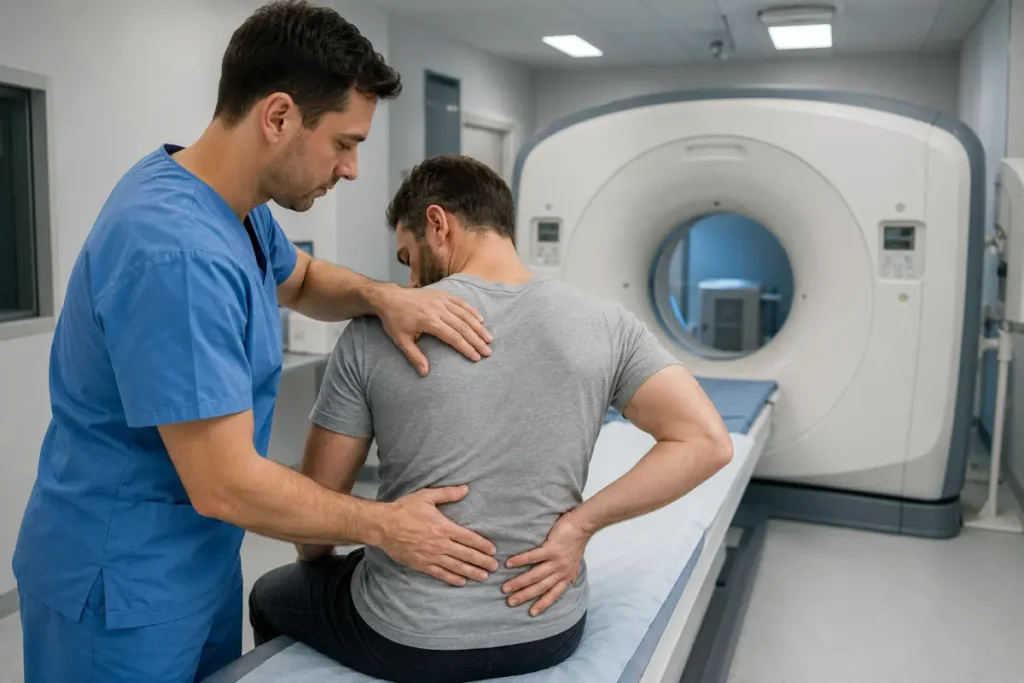
Spine CT with and without contrast
In most cases, spine CT is performed without contrast. This is usually sufficient to assess fractures, fissures, bone changes, deformities, degenerative processes, the position of metal implants, or consequences of injury.
Spine CT with contrast is not always prescribed. Contrast may be needed if the doctor needs to clarify an inflammatory process, tumor lesion, postoperative changes, the condition of soft tissues, or other situations where a non-contrast scan may provide an incomplete answer.
You should not choose CT with contrast on your own “for better accuracy.” Contrast enhancement must be justified by the medical task. If the referral indicates CT with contrast, you need to prepare before the procedure and report possible contraindications.
How is a spine CT scan performed?
A spine CT scan is quick and painless. The patient arrives at the medical center at the appointed time, completes registration, provides the doctor’s referral and results of previous examinations, if available.
Before scanning, metal objects that may enter the examination area should be removed. Then the patient lies on the scanner table. During the procedure, it is important to remain still because movement can reduce image quality.
The scanner performs a series of layered images of the selected spinal section. After that, the radiologist analyzes the obtained data and prepares a report. If CT is performed with contrast, before the procedure the medical staff additionally checks allergic reactions, kidney condition, chronic diseases, and creatinine test results.
How to prepare for a back CT scan?
No special preparation is usually required for spine CT without contrast. It is enough to arrive at the appointed time and bring medical documents that may help the doctor assess the situation correctly.
Before spine CT, it is advisable to bring:
- a doctor’s referral, if available;
- results of previous X-ray, CT, or MRI examinations;
- discharge summaries after injuries or surgeries;
- information about installed metal implants, if any;
- documents related to implants or surgical treatment;
- comfortable clothing without metal elements in the examination area.
If CT with contrast is planned, a blood creatinine test may be required. You should also report allergies to iodine or contrast agents, kidney disease, thyroid disease, diabetes, pregnancy, or breastfeeding.
Are there contraindications to spine CT?
CT uses X-ray radiation, so the examination is performed based on medical indications. The main limitation is pregnancy or possible pregnancy. The procedure may also be difficult if the patient cannot remain still due to pain or another condition.
For CT with contrast, there are additional restrictions:
- allergy to iodine-containing contrast;
- severe kidney failure;
- severe reactions to contrast in the past;
- certain thyroid diseases;
- decompensated diabetes mellitus;
- severe general condition;
- breastfeeding — requires a separate discussion with a doctor.
If you have chronic diseases or have previously had reactions to contrast, mention this during booking.
CT, MRI, or X-ray of the spine — which should you choose?
X-ray, CT, and MRI of the spine solve different diagnostic tasks. X-ray is often used as the initial method for assessing major bone changes, vertebral position, or consequences of injury. However, X-ray does not always show small fractures, complex injuries, or detailed anatomy.
CT is better suited for assessing bone structures: vertebrae, fractures, fissures, osteophytes, deformities, postoperative changes, and metal implants. It is a quick method that provides detailed layered images.
MRI is more often used to assess intervertebral discs, herniations, protrusions, nerve roots, spinal cord, ligaments, and soft tissues. If the doctor needs to see nerve structures specifically, MRI may be more informative.
The optimal method should be determined by a doctor. If the referral indicates CT of a specific spinal section, it is better to book exactly this service rather than replace it with another examination without approval.
Why choose HBMedical near Shuliavka for a spine CT scan?
HBMedical is a modern clinical and diagnostic center in Kyiv where you can undergo spine CT in a convenient location near Shuliavska metro station. The center is suitable for patients who need to quickly clarify the cause of back pain, check the spine after injury, assess the condition after surgery, or prepare for a consultation with a neurologist, traumatologist, or neurosurgeon.
Advantages of HBMedical:
- convenient location near Shuliavska metro station;
- address: Kyiv, 3 O. Dovzhenka St.;
- modern Siemens CT scanner;
- CT scan of the cervical, thoracic, and lumbar spine;
- CT scan of the coccyx and sacrum;
- CT scan of one spinal section with a metal implant;
- possibility of CT without contrast or with contrast when indicated;
- appointment online or by phone;
- diagnostics daily from 6:00 to 23:00;
- clear spine CT price;
- radiologist’s report based on the examination results.
The location near Shuliavka is convenient for patients from Shevchenkivskyi, Solomianskyi, Sviatoshynskyi districts, KPI, Nyvky, Lukianivka, Dorohozhychi, and other areas of Kyiv.
How to book a spine CT scan in Kyiv?
To book a spine CT scan at HBMedical, leave a request on the website or call the medical center. During booking, it is advisable to specify which spinal section needs to be examined: cervical, thoracic, lumbar, sacrum, coccyx, or a section with a metal implant.
If you have a doctor’s referral, dictate its wording to the administrator. This will help select the correct service, determine the price, and clarify preparation.
HBMedical — spine CT scan in Kyiv
Address: Kyiv, 3 O. Dovzhenka St., Shuliavska metro station
Service: computed tomography of the spine / back CT
Price: from UAH 1850
Appointment: online or by phone
Frequently asked questions about spine CT
How much does a spine CT scan cost in Kyiv?
At HBMedical, the price of a CT scan of the cervical, thoracic, or lumbar spine starts from UAH 1850 without contrast. CT with contrast costs from UAH 3800. CT scan of the coccyx and sacrum starts from UAH 2800. It is better to confirm the current price during booking.
Is back CT different from spine CT?
“Back CT” is an everyday term often used by patients. The medically correct name is spine CT or CT scan of a separate spinal section. Before booking, it is necessary to clarify which section needs to be examined: cervical, thoracic, lumbar, sacrum, or coccyx.
Where can I have a spine CT scan near Shuliavka?
You can undergo a spine CT scan at the HBMedical medical center in Kyiv at 3 O. Dovzhenka St., near Shuliavska metro station.
What does a spine CT scan show?
A spine CT scan shows vertebrae, bone structures, the spinal canal, fractures, fissures, displacement, degenerative changes, osteophytes, stenosis, postoperative changes, and the position of metal implants.
Which spinal section should I choose for CT?
The necessary section is determined by the doctor based on symptoms and the referral. For neck pain, the cervical spine is usually examined; for pain between the shoulder blades — the thoracic spine; for lower back pain — the lumbar spine; and for pain after falling on the buttocks — the sacrum or coccyx.
Which is better for back pain: CT or MRI?
CT is better suited for assessing bones, fractures, injuries, deformities, and metal implants. MRI is more often used to assess discs, herniations, nerve roots, spinal cord, and soft tissues. The choice of method depends on symptoms and the doctor’s referral.
Is contrast needed for spine CT?
In most cases, spine CT is performed without contrast. Contrast is needed only for specific indications, for example when a tumor, inflammatory, or postoperative process is suspected.
Is preparation needed for spine CT?
No special preparation is usually required for spine CT without contrast. For CT with contrast, a blood creatinine test and additional food-related recommendations before the procedure may be needed.
Is a back CT scan painful?
No, the procedure itself is painless. The patient lies on the scanner table and must remain still. Discomfort may be related only to back pain or the need to lie in a certain position.
Can spine CT be performed with a metal implant?
Yes, CT is often used for follow-up after spine surgery and to assess the position of metal implants. HBMedical has a separate service: CT scan of one spinal section with a metal implant.
Can I have a spine CT scan without a referral?
It is advisable to have a doctor’s referral to correctly determine the spinal section and the need for contrast. If there is no referral, it is worth consulting a neurologist, traumatologist, orthopedist, or another relevant specialist.





Саме до таких фахівців, в разі необхідності, є бажання повернутися!
























Need specialist help?
Order a callback and our consultant will help you choose a doctor and make an appointment at a convenient time for you!